








Canada’s electricity demand is booming, driven by EVs, industrial growth, and a surge in AI.
In this live conversation from the Conférence de Montréal, Heather Chalmers, Canada’s President & CEO, GE Vernova Canada and President, GE Vernova Hydro North America joins Goldy Hyder to unpack why energy has become a national priority, what’s accelerating demand, and how Canada’s natural advantages can translate into real economic opportunity.
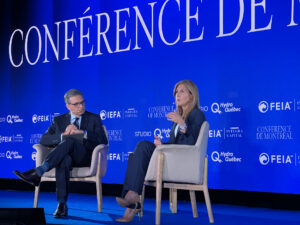
“I’ve always said Canada won the geography lottery. When we think about the natural resources that are incredibly abundant in this country and now the focus on water as well, we’ve got enviable trade corridors, unbelievable talent, you name it.”
From small modular reactors to carbon capture to the talent reshaping the energy sector, Heather lays out the urgency, the risks, and the potential in what she calls the emerging “energy supercycle.”
Heather Chalmers:
This is that opportunity to invest in innovation, to become the most competitive energy infrastructure supply chain in the world, to change that productivity narrative. Shame on us if we waste this moment and I know we won’t.
Goldy Hyder:
Welcome to Speaking of Business: Conversations with Innovators, Entrepreneurs, and Leaders. I’m Goldy Hyder, President and CEO of the Business Council of Canada. I want you to think for a moment about how much we rely on electricity in our daily lives. We don’t just use it to turn on the lights or to boot up our computers. Increasingly, we’re using electricity to run our cars, heat our buildings, power our digital infrastructure, and so much more. Our needs are in fact ballooning. So can Canada keep up? Do we have the capacity to meet ever-expanding electricity needs? I had the opportunity to talk about all of this with Heather Chalmers, president and CEO of GE Vernova, Canada. We spoke in early June at the Conference de Montreal. Here’s our conversation.
Good morning. It’s really great to be here with you, Heather, and with everyone in the room. Why don’t we just start first and foremost by talking about, we all know about GE, but then this brand change took place and you had became GE Vernova. Let’s just situate what exactly is that and what’s your role there?
Heather Chalmers:
First of all, it’s great to be here. Thank you for the opportunity to share a few comments. As Goldy said, I am with GE Vernova. My title is president and CEO of GE Vernova Canada. I also operationally run our hydro business for North America.
And for some of you who may or may not know, after 133 years, GE decided to spin itself out from being a conglomerate. And what that meant is over the last two to four years prior to that, we spun off our healthcare business. We spun off our aerospace business, of which we have a tremendous footprint in the province of Quebec. And during that period, we consolidated all of our energy technology businesses under GE Vernova. So ver for green, nova for new. And those technology businesses span generation, hydropower, nuclear power, in particular the small modular reactor, steam power, gas power. We do all things wind, onshore wind and offshore wind, and then grid. Our purpose, our singular focus is to electrify, to thrive, and decarbonize. And we just celebrated our two-year anniversary or birthday if you want to call it that.
Goldy Hyder:
Happy birthday.
Heather Chalmers:
Thank you very much. In early April.
Goldy Hyder:
All right. Now that we set the foundation there, let’s talk about in that two year period, there seems to be an elevated importance to electricity in terms of its strategic value. What fundamentally changed in that two year that allowed that to happen?
Heather Chalmers:
For a number of years, I think the discussion was around the energy trilemma. So how do you achieve sustainability but in an affordable and a reliable way? And with the geopolitics, I don’t want to say of today because it’s almost become unfortunately-
Goldy Hyder:
Every hour.
Heather Chalmers:
… the norm. And the focus on AI and the need for data centers, as well as increased industrialization and increased electrification. In addition to the trilemma, you’ve got a discussion around energy sovereignty, energy security, economic prosperity. And the net of all that is a renewed, not even a renewed, but a sense of urgency and how do you accelerate and scale energy investment and development to the likes that we just haven’t seen. And the panel before us talked about that.
Goldy Hyder:
Prime Minister Carney has really set forth this notion that this is a hinge moment, that this is an opportunity for Canada to really be ambitious and to really emerge and sort of stand up and be counted on these issues. What do you see as the structural challenges? And what are the advantages that Canada has in this ambition that we’re pursuing?
Heather Chalmers:
I’ve always said Canada won the geography lottery. When we think about the natural resources that are incredibly abundant in this country and now the focus on water as well, we’ve got enviable trade corridors, unbelievable talent, you name it. And subsequently, those things have led to a situation where our grid, for many of you who probably know, is over 80% clean as a starting point. And that’s an enviable starting point. However, when you get-
Goldy Hyder:
By the way, even higher in Quebec.
Heather Chalmers:
Well, it’s 99% in Quebec.
Goldy Hyder:
99% here.
Heather Chalmers:
But if you get one layer below that, each of the provinces have their own portfolio of energy. That means they’re starting with different assets, a different collection of assets. They also have different availability of assets. And what that means is as they strive to fulfill their energy goals, how they get there, the solutions are going to look very different. And in those differences allows Canada to innovate in ways that ultimately the rest of the world can learn from.
So I think about Ontario as an example. They will deploy the Western world’s first small modular nuclear reactor. Happens to be ours. But they’re going to do it in a way that will build IP, will build supply chain, that will benefit Canada, but also the rest of the world long term.
I look at Alberta as another example. As they figure out how to do carbon capture, they’re sitting on very favorable geology for sequestration of carbon. If they do this right, they can create an industry that will give back for many years to come. Case in point, we are developing direct air capture technology ourselves and we will deploy our first pilot plant, 1,500 tons, just outside of Calgary on Deep Sky’s campus. So those are just two examples in terms of technology innovation that Canada can show the rest of the world.
The third one I’ll talk about is around innovation and commercial arrangements. And I will tell you, I think Canada’s out front here too, in particular our crown corporations, which are getting much more comfortable looking at their energy needs through long-term partnership arrangements and long-term partnership arrangements that are not just two years but five years, 10 years, 15, 20 years. And that allows companies like mine to have certainty of volume. And with that certainty of volume, you can start to make the necessary investments in people or supply chain in order to deliver on that work. And Quebec and Ontario and the Canadian provinces are out front. So I think we’re starting off with a lot of advantages.
In terms of risk, there’s two that I would focus on. One is, do we have the talent to do the work? And do we have the supply chain in order to deliver on these massive infrastructure projects? Our opinion is as of right now, we do not. But it’s a good problem to have as long as we rally around and do the necessary things to make those investments.
Goldy Hyder:
So you may have answered my next question maybe inadvertently because it was going to be, let’s say the Prime Minister calls you and says, “Heather, you just mentioned urgency. I have that ambition. What are the one or two or three things that I need to do now that I can do now?” What would you say to him?
Heather Chalmers:
I would start with creating a map, almost an inventory of the projects that are already in the backlog and also the projects that are in the queue, whether there’s 100% certainty right now or not. And where are those projects going to be deployed across the country? So we have a sense of where, because location matters when you’re doing these types of projects. You can’t just move people around willy-nilly. You’ve got to understand where these projects, in a number of cases with energy or hydro, they’re in-
Goldy Hyder:
It is where it is.
Heather Chalmers:
They’re in very remote places. So starting off with that inventory.
And in addition to that, gain an understanding of our supply chain. Where do we have capacity? What is the type of capacity that we’re going to need in order to deliver on these projects? Details matter here. Details matter. So it’s got to be sort of second and third order level of detail. And then we can start to figure out where do we have constraints.
From a talent perspective, I will share our experience. We are constrained all the way from starting with engineers, nuclear engineers, hydro turbine engineers, you name it, all the way down to project directors, machinists, welders, pipe-fitters. It kind of hits the full gamut.
Similarly, when we look at our supply chain, we’re trying to do our own inventory of who can do large welded structures, who can do small and medium-sized machine parts. Those details matter. I am encouraged because the federal government just announced $6 billion-
Goldy Hyder:
…yeah.
Heather Chalmers:
… towards Red Seal craft labor. So they’re starting to appreciate the challenge of what we’re facing.
Goldy Hyder:
Let’s pick up on talent because that’s something that transcends any industry. I hear about it sector after sector. One of Canada’s calling cards, of course, around the world is we’re a welcoming society. We built on immigration. We’ve been largely targeting economic migrants. Now, we’ve had a bit of an issue over the last little while and a lot of reset seems to be taking place. Are you concerned about being able to get the labor that you need as fast as you need to do the things that you need to do?
Heather Chalmers:
One of the things I did over the last 12 months, I very purposefully went to go and visit our top suppliers in Canada, a number of which are in Quebec, to talk to them, to understand what it was going to take for them to grow, to increase their capacity, and certainly talent came up. A couple of things through those conversations, one is just getting access to the talent, whether that was different immigration policies, whether it was the opportunity to tap into underrepresented cohorts, whether that’s indigenous, whether that’s females. There are places where I think we can do a better job of attracting talent.
The third area was how to make apprenticeship programs more attractive. They are inherently expensive. They’re expensive just in terms of productivity. You’re taking somebody on your shop floor that they’re already at capacity and you’re asking some of your best people to now work at 50% productivity in order to train, and you’re paying somebody as you go through this process. So how do we make running apprenticeship programs more attractive and more investible for our small and medium size enterprises?
And then finally, I think our academic institutions, whether they’re post-secondary education institutions or otherwise, how do we train people with more vocational input into that training program such that when they graduate, their productivity, their impact is greater than what it is today? So I think there’s an opportunity there.
And then finally, I know that I’m kind of building on this question, but it’s important to me, how do we build on our technical training programs with soft skills? Why I say this is I think it’s something that we’ve lost. COVID, I don’t know, social media, but projects, despite the best of planning, it’s all about challenges. It’s all about problem-solving unforeseen challenges. And those partnerships that are able to do it through cooperation, through collaboration, through critical thinking, those are the projects that will be more successful, but we’re not graduating students that think like that. So I think in addition to the technical, the vocational, that those soft skills just become incredibly important.
Goldy Hyder:
Well, that’s a good segue to another area which you cannot be on a panel and not talk about, and that is the role of artificial intelligence in our industries and so forth. But what you’ve just made a case for is not just AI but HI, human intelligence and the importance of that. But how will AI play a role in the transition that we’re undergoing. And how is it that it’s in some ways addresses the shortage of labor that we’re still continue to face?
Heather Chalmers:
We’re right in the thick of this. We’re spending a lot of time with hyperscalers as well as our traditional clients, independent power producers, the Excels of the world and understanding what their pipeline looks like, what do they foresee as their needs?
We also, I mentioned because we’re in the continuum of energy technology, we have this opportunity to do a better job or optimize the integration of all of what’s required and to make a data center run optimally, especially when it’s most often connected to the grid. So what does that look like? That in practical terms for us, because of the demand, we do have a lot of hyperscalers and other clients that are placing orders with us ahead of time to make sure that they are securing their capacity to deliver on their commitments.
With respect to the human intelligence and I think like all of us as a company, we’re trying to integrate AI into how we do things to drive more efficiency. We’re lean, so quality, safety, delivery cost, how do we do a better job of that and how does AI enable it as a tool? And then how do we build AI into our very solutions in order to support better outcomes, better value delivery?
Goldy Hyder:
Productivity.
Heather Chalmers:
All of that. Absolutely.
Goldy Hyder:
Okay. Well, we’re speaking in Montreal and La Belle Province and there’s a great success story here when it comes to scaling electrification. I know you’ve looked at it. What do you think the lessons are for others?
Heather Chalmers:
First and foremost, I’ve got to commend Hydro-Quebec and the province for having the courage or having the foresight and then the courage to come up with a 10-year capital of investment plan of that magnitude. I think that’s not something that’s easily done. So number one is understanding the need and then coming up with the plan. And then they have been very purposeful in terms of making sure that they have the partners and securing that capacity for the long term.
I think they’ve also done a good job of appreciating that they don’t have necessarily the supply chain or the talent. And a subsequent announcement was a $250 million investment in human capital and how are they going to ensure that they … The latest stat I heard, 35,000 people in order to deliver on this energy capital investment plan in the province. That’s a huge undertaking, but they acknowledge it, they have the plans, they’re making the necessary investments.
And I think it’s just representative of how this province has always worked. And I share that because it’s not by accident that as GE Vernova Canada, 60% of our employees are based here. And we have supply chain in hydro manufacturing, we have supply chain in grid manufacturing here. We build wind turbine blades. And in fact, two weeks ago, the end of May, we just announced an acquisition of Robotech, which is an automation and AI company that we were already working with and now we’re bringing it 100% into the family. So I think there’s a lot to learn from Quebec.
Goldy Hyder:
One of the things that chief executives, amongst many things that they’re thinking about these days is the ongoing uncertainty in which we operate. You are a global company, you have global colleagues. How are you as a leader and how is the company navigating a lot of the uncertainty, whether it’s geopolitical, whether it’s trade, whether it could be on labor, AI and other issues, disruptions, how do you feel about how you’re managing that uncertainty?
Heather Chalmers:
The first thing I would say is sticking to your mission and purpose and understand what your swim lanes are and what they aren’t and making sure you stay true to that. The other one is building optionality in everything you do. And case in point, these infrastructure projects, you have to have an option A and option B and option C and have the humility to know when to call something-
Goldy Hyder:
To pivot. Yeah.
Heather Chalmers:
… and to say, “This isn’t working. I may have made a bet on this, but I’m humble enough to know that that’s not going to work so we’re going to have to pivot and go to option B and option C.” And I think just as a company, we do a lot of that.
I think the other thing is knowing what you can control and getting better and better and what you can control. We are a disciple of the lean methodology. So before we go and do anything, we look ourselves in the eye and say, “Have we eked out every ounce of productivity and capacity or whatever that may look like in our own backyard?” And the answer is typically no. So you’re constantly challenging ourselves to get better and better.
Goldy Hyder:
Now I know, and we’ve known each other a long time, but I know you’re passionate about the journey, about climate change, about doing better, and about making things more affordable and all that. Where do you think we are in that journey at a time in which all this uncertainty is out there, public around the world is largely concerned about affordability, where are we on this journey?
Heather Chalmers:
I think the sustainability journey, that proverbial train left the station a long time ago. I think the affordability aspect of it, maybe more the reliability piece of it wasn’t as understood a number of years ago as it should have been. I think that there’s a growing appreciation that it’s going to take an all-of-the-above approach in order to get there. And I talked in my opening remarks that this is where Canada has a real opportunity to play, I don’t want to say a first mover advantage, but act as an example because each one of our provinces is going to have to do things differently to achieve their goals and to do it sustainably.
Goldy Hyder:
Right. It’s an and not an or.
Heather Chalmers:
Exactly. It’s an and not an or. So I think this is just a natural evolution. Like anything, the pendulum swings to the right to get people’s head around something that might be new and then it tends to settle where it becomes more practical and affordable at a cadence that we can get things done, and that’s where I would say we are.
Goldy Hyder:
We were talking backstage. I just came from Phoenix, you’re going to Phoenix. There’s an example of a place that’s going huge on data centers, $167 billion investment from a Taiwanese semiconductor company. The emphasis that’s going to come on power, the need for power, is that not going to be in such a demand that it’s really going to be hard to keep up? That build the infrastructure fast enough, to have the people fast enough and that will affect costs ultimately?
Heather Chalmers:
Without question. That is why I’m on this stage to tell anybody who will listen to me, project delivery, cost certainty, and regulatory predictability will dictate whether or not you get access to capital and whether or not you can accelerate deployment. And there’s no question the energy supercycle is upon us. We need to be very thoughtful in terms of expanding that value chain in order to support it, so to do it in that predictable and affordable way.
We’re here talking about energy, but at the same time, we’ve got Canada that is going to increase its defense spending. The defense sector uses a lot of the same supply chain that the energy sector does, so that it’s just going to become even more critical that we wrap our arms around this.
But I will say what an opportunity, what an opportunity for Canada’s supply chain and more globally. The reality is there’s international trading corridors and supply chain, but I said that I’ve been out there meeting with some of our critical suppliers and trying to express to them, this is that moment because you know the volumes there, you have certainty of market. This is that opportunity to invest in innovation, to become the most competitive energy infrastructure supply chain in the world, to change productivity narrative. Shame on us if we waste this moment and I know we won’t.
Goldy Hyder:
Well, maybe in the last 50 seconds that remain, I’m going to ask you a question that we didn’t talk about because I just want to know the answer to this question, but what are you hopeful about?
Heather Chalmers:
I have two, 20 and 23-year-old children and I am incredibly passionate about Canada. I’m not going to lie, you know that. And I am hopeful that in this energy supercycle moment, in the opportunity to play a real superpower role, that we’re going to realize that potential. And both my kids, I hope both my kids play some meaningful role in that themselves. I have a daughter who is in her second year at university. She’s an engineering. She wants to be a nuclear engineer so I’m all in. And then I-
Goldy Hyder:
That apple didn’t fall far from the tree.
Heather Chalmers:
I know, exactly. My first summer job was at the Pickering nuclear power plant. And then I have a son who’s going into electrical and I just, I think, “Wow, what an amazing place for them to be and what an amazing moment for Canada.”
Goldy Hyder:
Well, I can’t think of a more amazing person to talk about it at a more amazing place to conclude the conversation. So thank you so much, Heather, and thank you all.
Heather Chalmers:
Thank you.
Goldy Hyder:
That’s my conversation with Heather Chalmers, President and CEO of GE Vernova Canada. We spoke in front of a live audience at the Conference De Montreal. If you would like to hear more of our Speaking of Business: Conversations with Innovators, Leaders, and Entrepreneurs, why not subscribe to our podcast? Search for Speaking of Business wherever you get your podcasts, or go to our website at thebusinesscouncil.ca. Yes, it’s thebusinesscouncil.ca.
Speaking of Business is a production of the Business Council of Canada. Our thanks to Micko Casano of the International Economic Forum of the Americas for production help, and as always, Will Mcintyre and his amazing team at Pop Up Podcasting in Ottawa. Until next time, I’m Goldy Hyder. Thanks for joining us.
From Small Town to the C-Suite: Laura Dottori-Attanasio, Element Fleet Management

50 Years of Business Leadership in Canada: Leading with Purpose

Balancing Business and Social Mission: Zahid Salman, President & CEO of GreenShield