






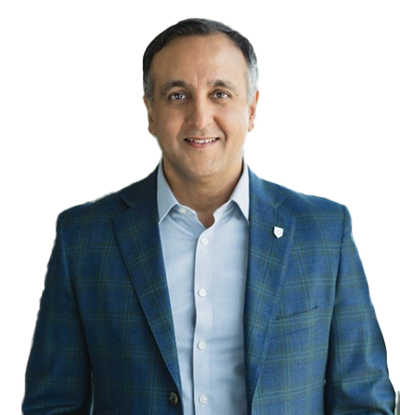
A nonprofit, a bold mission, and a fresh way of thinking about healthcare- this episode tells the story of Windsor-based GreenShield.
From its roots in Southwestern Ontario helping Canadians get the medicine they need, to becoming a national healthcare and insurance company, the podcast explores how the organization grew without losing sight of its purpose.
“We believe that healthcare is a right, not a privilege,” explains Zahid Salman, GreenShield President and CEO. “So this universal cornerstone that we’ve all lived on ever since we adopted the Canada Health Act is critical to us.”
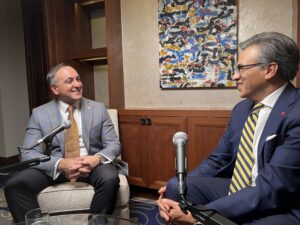
In conversation with host Goldy Hyder, Salman discusses GreenShield’s origins, why the company is putting an emphasis on mental health support and how corporate culture influences the work they do.
With headquarters in Windsor, Ontario, he even shares what makes for the best Windsor Pizza!
Zahid Salman:
There’s two ways we can go, right? We can either seize this opportunity, tap into the private sector and really get our healthcare system back on a better performing route, or we can get stuck in our dogma that only the public sector can provide healthcare and there is no role for the private sector. So that’s what keeps me up at night.
Goldy Hyder:
Welcome to Speaking of Business: conversations with innovators, entrepreneurs, and leaders. I’m Goldy Hyder, President and CEO of the Business Council of Canada. When the United States implemented tariffs on a range of Canadian products in 2025, some cities felt the effects more than others. One of them was Windsor, Ontario. With an economy closely tied to the auto industry, many people felt worried about the impact tariffs could have on their lives and livelihoods. It prompted GreenShield to offer free mental health support to Canadians who were struggling with stress and anxiety. But providing community support is nothing new for GreenShield. The company began nearly 70 years ago in a Windsor pharmacy with a simple belief, healthcare should be accessible to everyone. Today, it’s Canada’s only national nonprofit healthcare and insurance organization, reinvesting excess earnings to support underserved communities across the country. Zahid Salman has been at the company’s helm for more than seven years. As president and CEO, he has helped grow the company while continuing to advance GreenShield’s mission of better health for all. Welcome to the podcast, Zahid.
Zahid Salman:
Thank you so much, Goldy. Happy to be here.
Goldy Hyder:
Look, let’s start at the beginning. You and I were chatting just before we hit the record button about our own stories. You came to Canada when you were five years old. I was fascinated to read that your father as an ambassador was even ambassador to Canada once upon a time. Tell me about that experience when coming here for the first time.
Zahid Salman:
Yeah, it was my grandfather. My father’s father was Pakistan’s ambassador to Russia, England, and Canada. So when he was stationed in Canada, that’s when my father went to-
Goldy Hyder:
When would that have been?
Zahid Salman:
That would have been in the 1960s under Bhutto, the father. So my father spent some time at Ashbury College when his father was stationed here. So that’s what drew him to Canada. He had a wonderful memory from his time there. So when I was born, I was born in Karachi. We moved to England first. He worked there for a couple of years, but then he moved the whole family to Canada in the mid-1970s and we came to Montreal and I’ve been here ever since.
Goldy Hyder:
Any memories of the early days here?
Zahid Salman:
It’s so great that you and I can do this podcast today in Montreal. It’s sort of coming home a little bit for me. So we grew up on the West Island. I did all my schooling, elementary school, high school, CEGEP here in Montreal. I absolutely love the city. Many of my best friends to this day are here. We go once a year, a small boys group. We go and do trips once a year. I’ll be seeing them while I’m in town this week. Because I grew up here, I cannot root for the Toronto Maple Leafs. So I’m no longer a Habs fan, but I still hate the Leafs. So that’s a legacy of Montreal.
Goldy Hyder:
That’s one thing does unite Canadians in many parts of the country.
Zahid Salman:
It really does. Yeah, but it’s harder for me when we live in Toronto to not root for the Leafs, but that is what it is.
Goldy Hyder:
Tell me about your family.
Zahid Salman:
Both my parents are still alive. I’ve got a sister as well who’s married. We have a very exciting family. So my dad’s a CA, my sister’s a CA, she married an actuary, I’m an actuary. So you can tell we’ve got that financial acumen-
Goldy Hyder:
Good math genes in that family.
Zahid Salman:
Seriously. But then one day I brought my future wife home and she went to McGill. She had political science and women’s studies and became a teacher. And it took my father a while to get used to a non-analytical person in the household. So my wife and I now have three children. I’ve got two daughters. One’s 25, one’s 23, and we’ve got a 21-year-old son. The two girls have all completed undergrad. One’s in law school, the other’s figuring out what to do next. And our son is in software engineering at University of Waterloo. So they’re all doing well.
Goldy Hyder:
Terrific. Well, you and I just completed attending a Business Council of Canada meeting with chief executives from across the country. We had sobering discussions about a lot of the issues that are at play. One of the things that seemed to come across a little bit more was how concerned people seem to be about the state of young people in Canada, the youth of Canada. Their sense of life is not affordable, life is going to be hard, I don’t have the same opportunities. And I’m leading into the conversation about mental health and so forth, but tell me, do you hear about that? Do you feel that? I talk to my girls, you must talk to your kids. What’s your sense of where young people are today?
Zahid Salman:
Yeah, I think there’s a lot more anxiety in general about their future. They’re doing all the things they were told to go to a university, getting a degree in an area where they can get employed, finding employment, but still, can they really afford to build that house, build that life by themselves, independent of support from their parents? So I hear that a lot, not just from my kids, but from parents of other children too. And you’ve seen that to your point around mental health, right? We’re estimating now that one out of two Canadians will probably have a mental illness at some point in their lives. And beyond full mental illness, just the pressures and the anxiety that causes and needing to build more resilience in society to handle mental health and all the pressures that young generation faces today. Think about social media and all those things that we didn’t have to deal with when we were their age. So it is a concern and we’re seeing it.
Goldy Hyder:
Well, I think we’ll come back into that theme, but let me just… I talked about you. Let’s talk about the company that you run. Like many companies, Canadian companies, GreenShield has a pretty interesting, fascinating origin story. Tell our listeners about how it started.
Zahid Salman:
Yeah. So as you noted in the opening, we’re proudly Windsor based. We’re a national company now, but we started in Windsor. And the founding story is something I tell all the time when describing GreenShield because this continues to be core to who we are today. So our founder, William Wilkinson, was a pharmacist based in Windsor, and there was a very specific event that led him to create what ultimately became GreenShield. And that was when a young mother walked into a store in Windsor and she had two prescriptions to fill. So this would have been the 1950s before Medicare was in Canada. And her challenge was she could not afford both prescriptions, one for herself, one for her young daughter. So she ended up going without the medication she needed so that her daughter wouldn’t have to.
So this had a very big impact on William and it led him to do two things. So first thing he did was created North America’s first prepaid drug plan. So for any of your listeners who are close to employee benefits, they would know that a prepaid drug plan is one of the most common component of benefits on both sides of the border. That’s where the idea started. The second thing he did was he created GreenShield as a nonprofit with a social mission of improving access to prescription drugs for all Canadians. And that notion of being there for a broader social mission around improving access to healthcare continues to be something that guides us 70 years later almost.
Goldy Hyder:
So tell me how the company’s evolved then. Where are you now and where are you going, I suppose more importantly?
Zahid Salman:
Yeah, for sure. So I mean, the company grew from those humble beginnings. Almost 70 years in now, we’ve diversified the organization. So for call it 60, 65 years, all we did was provide coverage for health and dental benefits. That led to some good growth. So it took about 50 years, all organic growth, and the company hit one billion in gross revenue for the first time. Then 10 years later in 2017, we hit $2 billion of revenue. Then we started to implement this diversification strategy. We believed in this concept of not just improving access by providing insurance coverage, but by improving access to healthcare by actually delivering the healthcare services for which we were covering under insurance plans. So it’s this notion of coverage and care together or the vernacular we’re using nowadays is payer provider. The payer is the stuff an insurance company does around paying claims and the provider is this provision of healthcare services. So bundling the both together to really reinvent the patient experience.
And that’s driven tremendous growth for the organization. So I mentioned the two steps over 60 years that it took us to get $2 billion. When we implemented this strategy in 2018, we have now gone from $2.3 billion of gross revenue when we started to we surpassed $6 billion in gross revenue last year. So we’ve passed the three, four, five, and $6 billion thresholds in seven years, whereas it took us sixty years to past the first two.
Goldy Hyder:
That’s quite the growth.
Zahid Salman:
So it’s something that the country has really embraced, that plan sponsors who provide these benefit plans have really embraced. And it’s comes at a time when our Canadian healthcare system is struggling.
Goldy Hyder:
Yeah, I was going to say that. You’re meeting the moment.
Zahid Salman:
That’s the need that we’re filling is some of the gaps in our publicly funded healthcare system.
Goldy Hyder:
Help us understand the operating model, if you will, because the company is rather unique in that way.
Zahid Salman:
It is. It is. Yeah. So we’re proudly structured as a nonprofit. And oftentimes when I share that story, people say to me, “Well, that means you’re not really a business, are you?” So I always try and say, “No, in fact, it’s the actual opposite,” right? Because all of our social good that we do comes from the business earnings that we generate. So as a nonprofit, the very top of our structure, we’re a non-share capital entity, so we have no external shareholders. So we then, instead of dividending back out to shareholders, we dividend our excess earnings back out to local communities to run these social impact programs that are core to us.
So we have these operating businesses, insurance, healthcare, administration. These are for profit companies owned by a holding company. In each of those for profit companies, we compete head to head against some very large for profit companies. We compete on all the same commercial metrics. We say to ourselves, no margin, no mission. So we compete very, very hard. And then we get to do the good with all the fruits of that labour. So while most of our publicly traded competitors would take those excess earnings and pay dividends and target things like a 40% dividend payout ratio after tax, we take that same quantum of dividends, so call it 15 to 20 percent pre-tax, which is about 40% after tax, and that’s what we use to fund social impact causes. So we had over this period where we experienced significant growth.
Also, our primary objective was to take that growth and reinvest $75 million over the strategic planning period to improve the health and wellbeing of a million Canadians and invest in social impact programs around mental health, around essential medicines, around chronic disease management and oral health. So areas that are core to our business where we have a right to play and where we have service capability in addition to financial capacity to advance the social mission. So we’re very proud that we have helped a million Canadians improve their health and wellbeing through the period of this high growth strategic plan.
We’re even more ambitious now as we look ahead to 2030. So we think that by 2030, we can double the size of the company a second time, but by doing so, we can enhance the level of social impact even more. So our social impact targets for 2030 is invest $200 million to improve the health and wellbeing of three million Canadians, an incremental three million over the million that we improve through the 2025 plan.
Goldy Hyder:
How does an actuarial… I want to understand how an actuarial… You should have been in insurance somewhere. How do you end up in healthcare specifically? What was your journey to get to where you’ve gotten to?
Zahid Salman:
Growing up in Montreal, I was in CEGEP and we had a career fair. At that point, I didn’t know what I wanted to do when I graduated, but I knew I liked math, I knew I liked statistics. I knew I no longer liked engineering at that stage. And it was just by happenstance that we had a career fair where this actuary came. I said, “Well, what the heck is an actuary?” I never even heard of it before. And they said, “Oh, well, we combine mathematics and statistics to serve clients.” I said, “Well, that sounds cool. Those are the two areas I’m really interested in. ” Then I saw on the jobs almanac this year, this would have been in the mid to late 1980s that the actuarial profession was ranked the number one profession in the jobs almanac in terms of opportunity, in terms of compensation, in terms of work-life balance. Many of that stuff ended up being untrue once I got into it, but it drew me into the profession.
So I started as a pension actuary, consulting to clients. As I was consulting around pensions, it was common to start consulting around group benefits and healthcare and things like that. So that’s where some of the interests came. The social impact part… So my whole career before GreenShield was working in publicly traded companies, but I always had this passion for doing broader social good. And that really came from the experience of my grandparents. So as a typical South Asian family, what happens when the grandparents get older, they often come and live with the parents. So all four of my grandparents over time moved from Pakistan to Montreal to live with us in the same house in Montreal. And two of them were afflicted by Alzheimer’s. So wanting to help people afflicted from Alzheimer’s or other significant healthcare issues is something that was ingrained in me from a young age watching what my parents went through. So at GreenShield, I got to do both. I got to combine my passion for business with my passion for doing social good around healthcare.
Goldy Hyder:
We started off talking about immigration and being an immigrant to Canada. I want to return to that theme because as we continue to hear from our colleagues across this country, this is a big issue, the issue of immigration, loss of consensus on that issue. I still believe it’s a quality, not a quantity. They want to focus on the quality of the people that are coming. We have labour challenges, foreign skills accreditation, labour mobility issues. How is your business addressing those issues while we have this other issue of artificial intelligence coming in, affecting the nature of work, the kind of skills that we need. Seems like a lot’s going on with a core piece of everybody’s business, which is my talent.
Zahid Salman:
Absolutely. Yeah. We’re fortunate to have a very diverse workforce at GreenShield. So we’re almost 2,000 people now across the country.
Goldy Hyder:
Across the country, yeah.
Zahid Salman:
Yeah. About two thirds of those would be women and many of the 2000 would be racialized individuals as well, many of whom are immigrants to Canada. So I think immigration needs to be disciplined, but it’s a good thing, right? You think about not just talent capacity, but you also think about the aging population, right? How are we going to fund healthcare? How are we going to fund retirement plans-
Goldy Hyder:
Who’s going to work in healthcare?
Zahid Salman:
If the population’s aging and the workforce is declining? Who’s going to work in healthcare? Exactly, right? So we need to find a way to successfully onboard the right level of immigration, sustain the things that we as Canadians view is very valuable, right? At the same time now, technology enables us to think of the workforce a little bit differently, right? There are some tasks that are very manual that perhaps we can automate to allow people to really add value in the roles and jobs and functions that they can add the most value in. So we’re thinking about how can we use AI to enable people. So sort of the thought of, you probably heard this saying, AI isn’t coming for your job, it’s coming to your job to make you better at doing your job. So we’re trying to think about how do we do that and really enhance the capability of our talent as opposed to AI being a risk for jobs, right? Because we’re a unionized workforce, so you can think about how our union, Unifor, would naturally be concerned around what impact could AI have on job security. So we regularly talk to them and try involve them actively in the use cases that we’re thinking about from an AI perspective and give them comfort that they’re not there to eliminate jobs, they’re there to streamline the tasks that the people do.
Goldy Hyder:
Let’s explore that, the relationship between business and labour. It seems to be functioning well for you. What makes it so?
Zahid Salman:
We have such deep history with organized labour that has been a critical part of GreenShield’s success. So when William Wilkinson came up with that prepaid drug plan, it was very hard for him to find employers who would adopt that in their benefits plan. So at that time in Windsor, automotive was already a very large industry. This is a time that predates the Canadian Auto Workers, but you had the United Auto Workers Union was active in Canada, in Windsor, given that was a big industry there. And our founder, William Wilkinson, worked with the leader of the United Auto Workers in Windsor to say, “Look, I’ve got this really cool concept around being able to provide access to affordable medication in employer sponsored plans. And you represent GM, Ford, and Chrysler, I think this could help all of you. Can you help me convince those employers to adopt it in their benefit plans?” And that head of, it was known as UAW at the time said, “Sure, absolutely.” But there was a quid pro quo.
So the quid pro quo was we needed to let the UAW unionize our workforce. So some of our roles from that day on became unionized, claims, contact centres, some of the IT roles, and it formed this basis of a wonderful partnership. So not only did our founder get his benefits plan designed into those three employers, but think about all the adjacent employers in the automotive sector, and we became the go to provider for that. So Unifor helped us grow, and we’ve had a very collaborative relationship that way. So that’s why there’s a very close ties between GreenShield, Windsor, and CAW/Unifor, in particular. That’s where it came from.
Goldy Hyder:
Well, it’s good you mentioned autos because I wanted to ask you about an op-ed that you wrote not too long ago, which was called Trade Wars Impact Mental Health. It was in the Windsor Star. What made you write that?
Zahid Salman:
There’s just a lot of stress in Windsor because so many people work in the automotive sector. And if you look at where the tariffs have really hit hard, that’s one of the sectors where the tariffs have had real immediate impact on job security. And we’re fortunate because our business is only in Canada, we haven’t been as directly impacted by the tariffs. Yes, we do have some clients, particularly in the automotive sector who have been impacted, but overall we’re quite diversified from client perspective. So our business has continued to remain resilient and strong through this period of uncertainty. So we wanted to give back and really support those who are going through the anxiety that this trade war is causing, right?
So given we’re in the business of mental health, we have said, we’ll take a few of our counseling sessions and give those free of charge to anyone who is experiencing anxiety, but doesn’t have access to mental health supports. And we really wanted to do an issue with a focus on the Windsor based community, but then we expanded it right across the country.
Goldy Hyder:
Why mental health? I mean, there’s so many things out there, right? It could have been hunger, it could have been poverty, could’ve been all kind of-
Zahid Salman:
Absolutely.
Goldy Hyder:
What made you go to mental health?
Zahid Salman:
Yeah. So our business model, you asked a little about it earlier. So there’s this professor at Harvard Business School by the name of Michael Porter, and he came up with this concept of creating shared value, right? It’s sort of, in his mind back in 2011, it was the evolution of philanthropy or the evolution of corporate social responsibility, which were good things, but they’re really just dollars that you contributed to a cause that may or may not have been tied to your business, right? The notion of creating shared value is that the business and your social impact activities are in lockstep, one supports the other. So the better my business does, the stronger force for good I can be. The stronger force for good that I am, more clients will want to buy my services, which then completes the circle of, as I grow, I’ll have more money to do more good with. So that combination was critical.
So when we thought about diversifying, we wanted to go in areas that are core to our social mission and our social mission around better health for all. So what healthcare services could we have a right to play in with relevance? Well, it would be the healthcare services for which we provide insurance coverage or that are in high demand by benefit plans. Mental health is in huge demand by benefit plans, right? As the stigma has started to lift around mental health, employers have been providing access to more and more supports because there’s high employee demand. And there’s ROI for employees. There’s a study by Deloitte that shows there’s a two to one ROI on any spend an employer makes in a mental health program. They’ll get that back and improve workforce productivity. So there’s a business need for us to get in and it helped us solve a social problem aligned with our social mission. So we chose mental health.
Goldy Hyder:
Win-win. Truly a win-win.
Zahid Salman:
And we just recently launched what we hope is going to become a very impactful program focused on youth mental health. So this would be youth from the age of 15 to 29. Many of them are in a high school or post-secondary institution. You think about the stresses that they go through. We’ll bring our counseling and therapy services and our financial capacity to bear, but we’ve partnered with some of the best known youth mental health organizations in the country like jack.org, like Tel-jeunes here in Quebec. We partner with Indigenous and Black mental health organizations as well to make sure there’s an inclusive aspect to the care. And we’ve launched this solution and this ecosystem right across campuses in Canada. And we’re hoping that’s going to help us really have the kind of impact that we need and want to have around improving the health and wellbeing of Canadians.
Goldy Hyder:
You’ve mentioned the better healthcare for all, sort of your north star, your mission. For many CEOs, the importance of getting the corporate culture right is so key. Talk to us about how you at GreenShield and you as a CEO approach corporate culture.
Zahid Salman:
Corporate culture is the foundation of everything. So when we speak about culture, we talk about our culture exists at the intersection between purpose, passion, and performance, right? Because no margin, no mission, that’s the performance part. The purpose is why are we’re doing this, for better health for all. And the passion that our employees get from fulfilling a broader purpose beyond enriching shareholders is really what brings the passion to allow us to succeed.
So when we started this diversification journey, we were very deliberate about how we wanted our culture to evolve within that journey. So the first thing we said was we wanted to protect the parts of GreenShield that made us great for 60 years as just a health and dental provider. So those are things like starting with the social mission. So that wasn’t going anywhere. And in fact, diversification was going to allow us to amplify the social mission with more impact. Everything done on a team basis, we wanted to make sure we were not allowing silos to pop up as we diversify that stopped us working together in teams to serve our clients. And the third element was that very, very strong client focus. Not just a plan sponsor or employer who’s paying for our services, but that patient plan member at the end who’s benefiting from our services. How do we help them live their healthiest lives? So those are the parts of the culture that we wanted to protect.
Then we had to think about, well, to be successful in the future, what were the cultural muscles that we wanted to bring on? And those are things like speed and agility. So we compete against some very, very large employers. We’re much smaller than them despite our recent growth, so our competitive advantage over them is that speed and agility. We need to build that cultural muscle in. Commercial mindset was another one that we wanted to think about from a cultural muscle perspective, which may be odd for a social enterprise to care about commercial mindset, but again, no margin, no mission.
Goldy Hyder:
You get that wrong, you’re not going to have anything else to do.
Zahid Salman:
Exactly. So the better we do as a business, the more good we can do, we need more cultural muscle around commercial mindset. So we compete on all the same metrics our competitors do. The next one was inclusion. It’s not just as employer, but when you think about what we do, from a social impact perspective, we target underserved and disadvantaged populations. We’re one of the first insurance companies to launch inclusive benefits, whether that’s around fertility, whether it’s around transition. As the workforce and society has evolved, making sure our offerings are inclusive enough to keep up with the trends. And finally, as an employer, we want to build a workplace where you can feel free and safe to be your authentic self. So that inclusion was another very key part of our culture. So we’ve been very deliberate at each step of our transformation on culture.
Goldy Hyder:
How hard is that to do, to build a single uniform corporate culture in a country like Canada? I mean, you live in Montreal, I come from Alberta. We know how different this country can be in parts, but how do you knit it and gel it together? And if you can do it in a business, can you do it in our country?
Zahid Salman:
It is very hard. And I think that’s the spirit of your question. So not only are we now doing it with a national footprint and there’s differences in culture geographically, we’re doing an environment where we’re acquiring companies. So for the first 65 years, GreenShield made no acquisitions. Then to really launch our diversification, we did eight acquisitions in 18 months. So now we’re bringing on board all sorts of different employee groups who aren’t as grounded in the social mission as we used to be. And then you’re just doing all this at a time where you’re introducing massive change into the organization. It’s been a big deal, especially for longstanding employees to transition from we only do health and dental to now where this fully integrated payer provider that combines coverage and care. So it’s been a challenge, right? But we’ve tried to use culture as a north star to help manage the change that we’re going through. And there’s been bumps. I have this saying that I’ve used change is hard at first, messy in the middle, and gorgeous at the end. I think we’re still in the messy in the middle phase-
Goldy Hyder:
Messy part.
Zahid Salman:
But we see gorgeous in the end over the horizon.
Goldy Hyder:
Your quote on change reminds me of a quote on change I saw on a church billboard many, many, in fact, decades ago now in Calgary. And it said, “The only one looking forward to change is a wet baby.”
Zahid Salman:
I might have to use that one.
Goldy Hyder:
Now, speaking of change, one of the big sort of taboo items in Canada is to discuss and debate our healthcare system, the future of our healthcare system, the need for optionality in our healthcare system. How are you navigating that question of what role private healthcare should play in our healthcare system, our universally funded healthcare system?
Zahid Salman:
Yeah. So there are so many benefits of our approach to healthcare in Canada, particularly when you compare us to other countries, this notion of a universal healthcare plan. And GreenShield philosophically is very aligned with that. We believe that healthcare is a right, not a privilege, right? So this universal cornerstone that we’ve all lived on ever since we adopted the Canada Health Act is critical to us. At the same time, I think we all have to recognize, and more and more people have recognized over the last several years that our healthcare system is somewhat broken right now. It is not serving the people in the way it’s intended, right? One in five Canadians do not have a family doctor. Of those who do have a family doctor, often takes at least a week to get in front of them, right? Having access to a waiting list is not access to healthcare.
So what solutions are out there? Part of our problem is a human resources problem, right? So we absolutely need to get more healthcare practitioners into the system. That’s going to take time.
Goldy Hyder:
Technology-
Zahid Salman:
Technology can absolutely help, right? So the whole notion of AI automating some routine tasks so that the healthcare practitioners we have can really focus on patient care, I think that will absolutely add value. The other opportunity that lies out there is how can the private sector help enable the delivery of publicly funded care? So I’m not talking about you go and pay for this. I’m still talking about a universal publicly funded system, but the private sector enabling it because we have our innovation, we have our technology, we have our human resource capacity. We can bring all this to bear and it’s right there.
And I hope that GreenShield can be an example of how this can be done in the country because we’re a nonprofit. And I think the fact that we’re a nonprofit makes us somewhat less offensive to some of the policymakers who would need to get on side with the notion of private sector supporting the delivery of publicly funding healthcare.
And we’re already doing a couple of cases. So in Ontario and Nova Scotia, we are the service provider who’s delivering what they call internet-based cognitive behavioral therapy service. So this is mental health therapy paid for with your OHIP card in Ontario, but delivered by GreenShield. So why isn’t there more and more opportunity for us to do things like that and add capacity to the system?
Goldy Hyder:
There’s a classic question you get asked is what’s keeping you up at night.
Zahid Salman:
Yeah.
Goldy Hyder:
So what’s keeping you up at night?
Zahid Salman:
Yeah, we’re at this incredible inflection point. We spent the last day or so talking about it here at the Business Council of Canada meetings, and that applies to the healthcare system too. We are at this inflection point where we’re recognizing the system needs fundamental change, where we’re recognizing now for the first time since I’ve been in the industry, that there is a potential role for the private sector to play to support it. There’s two ways we can go, right? We can either seize this opportunity, tap into the private sector and really get our healthcare system back on a better performing route, or we can get stuck in our dogma that only the public sector can provide healthcare and there is no role for the private sector. So that’s what keeps me up at night.
Goldy Hyder:
Where do you think Canadians are on that? What’s your read of the pulse and the mood of the Canadian public?
Zahid Salman:
Yeah, I think the whole reason now that there’s more openness to even having a conversation around private sector supporting delivery of public funding healthcare is because Canadians are there. They want to get in front of a family doctor, right? And as long as there’s no cost barrier to access, they don’t care how it’s delivered. And they want and recognize that change is needed because the system is not sustainable the way it’s set up right now.
Another thing that you talked about today that really resonated with me was the whole notion of regulatory burden, right? So if you ask me what worries do I have from an industry perspective, the regulatory burden on the life and health insurance industry in Canada has become overwhelming. So we’ve estimated that as an industry, so life and health insurance, that the regulatory burden costs our industry about $1.3 billion a year, which is 62% higher than it was in 2019. We estimate that as an industry, we’re subject to about 40 different regulators. In one country, 40. The C.D. Howe Institute did this study. The broader financial services industries would include banks as well as the insurance companies. Based on the C.D. Howe Institute study, 22% of payroll costs in financial services go to regulatory compliance. Do you know what that number is in the U.S.? 2%. How do we compete-
Goldy Hyder:
How do you compete?
Zahid Salman:
When ours is 22 versus 2?
Goldy Hyder:
What’s the impact of that on the customer, your patient?
Zahid Salman:
Exactly. Higher premiums, less innovation, more fragmented services, because we need to manage all these fragmented regulatory systems-
Goldy Hyder:
20 point spread’s a big spread.
Zahid Salman:
It’s huge. This is not a small… It’s 10x, right? 2% versus 20%.
Goldy Hyder:
So are you hopeful as you look forward about your business?
Zahid Salman:
With the new government in place, we’ve been talking to them regularly about regulatory burden, and they’re saying all the right things, right? And I really do feel that with Prime Minister Mark Carney and the team he’s assembled, that there’s a desire for change and for addressing some of the biggest issues that are holding us back as a country. And I think it’s not unique to life and health insurance, this notion of regulatory burden. So I think something will be done, yeah.
Goldy Hyder:
Well, as my dad likes to say the problem in Canada is there aren’t enough problems, so we make them all up and this overregulation is a great example of it. Let’s conclude before I get to the really tough part of the discussion on Canada itself. We talked earlier, we started off with we came to Canada, fully utilized the opportunity that they give you. How are you feeling about Canada right now? What is it about Canada that makes you hope for the future?
Zahid Salman:
Yeah. I think from a hope perspective, I think some of the turbulent times of the last year or so have really woken us up and rallied us. There’s a lot of division. Probably from a worldwide perspective, the thing that worries me the most is just the level of division that’s there. But in some ways, what we’ve gone through in Canada last year or so seems to be uniting us, and really thinking about what opportunities do we have to continue to, as you say, and I fully agree with it, continue to have strong relationships with the United States because they’re our biggest, most important partner. But then also look at what other kinds of relationships we can have that will allow Canadians to be successful well into the future, and alleviate some of the things we were talking about earlier around the younger generation and their fear for affordability and how will they be able to live their best lives given some of the pressure. So that’s my hope.
Goldy Hyder:
All right. On that note, as I mentioned, now we get to the really tough part of the podcast. This is the rapid fire question. There are some right answers and there may be some wrong answers. If you really go off script, I’ll have to call you out on it, but let’s see where we go. Easy, favorite food?
Zahid Salman:
My favorite food is probably Spanish tapas.
Goldy Hyder:
Spanish Tapas, okay. We haven’t had that answer before, I think. Best place to get a Windsor pizza?
Zahid Salman:
Oh, we can spend hours talking about this, Goldy.
Goldy Hyder:
We’ll have to come and have some then, it sounds like.
Zahid Salman:
I will personally escort you. So it’s a bit of a controversial question since we’re probably going to play this for others. I’m not going to pick the best, I’ll tell you the most famous, which is the original, Antonino’s, because it’s a big controversy in Windsor who’s the best, but you’ll never go wrong at Antonino’s. Do you know why Windsor Pizza is so famous?
Goldy Hyder:
No.
Zahid Salman:
So it’s won many awards for best pizza in Canada. One year won number three pizza in the world. So it’s got a thin crust. For the pepperoni that they put on it, they shred it because the circles of pepperoni, they attract the oil and the oil sits. The shredded pepperoni, the oil just evenly distributes. Local made cheese that’s supposed to be the best there is, and then something as particular as mushrooms. So many pizza makers put fresh mushrooms on their pizza, which when you heat at high temperatures, it dries out. So in Windsor pizza, they use canned mushrooms, which is fresh and tender when you heat it. So for all these reasons, this is why it’s so famous and you have to come and try some.
Goldy Hyder:
I’m getting hungry. We talked a lot about mental health. Let’s ask you, what do you do to protect your own mental health?
Zahid Salman:
Yeah. I mean, so this is an area where I need to get better at because I grew up at a time where you didn’t really talk much about mental health. There was a stigma around it. And this is where my kids, I think, have been excellent. Not just the business that I’m in at GreenShield, but how my kids proactively manage their mental health in the same way that I have for many years proactively managed my physical health. So just getting more deliberate about giving myself time to decompress, to get away from work, to engage in the stuff that really matters, which is friends and family. Those are some of the ways that I try and protect my mental health while I continue to spend long hours at work.
Goldy Hyder:
Do you have a favorite sport?
Zahid Salman:
Favorite sports to play are any racket sports, so tennis, squash, slowly getting into pickle ball and-
Goldy Hyder:
Nadal or Federer?
Zahid Salman:
Oh.
Goldy Hyder:
Federer.
Zahid Salman:
Okay, good answer. But favorite sports to watch would be basketball and hockey.
Goldy Hyder:
Do you have a favorite sport memory?
Zahid Salman:
Yes. So I grew up in Montreal, as I said, and I used to be a huge Habs fan. My favorite player was Guy Lafleur.
Goldy Hyder:
The Flower.
Zahid Salman:
So one day I got to meet him-
Goldy Hyder:
Wow.
Zahid Salman:
And that’s probably my best memory. I’ve got a signed jersey hanging in my house in Toronto.
Goldy Hyder:
Fantastic.
Zahid Salman:
Yeah.
Goldy Hyder:
Thank you for doing this. It’s been a pleasure talking to you and learning a little bit more about GreenShield, but also thank you for what GreenShield does for Canadians. Your leadership is valued.
Zahid Salman:
Well, thank you for giving your platform to share the story. It’s been very enjoyable. Thank you, Goldy.
Goldy Hyder:
Zahid Salman is president and CEO of GreenShield. Speaking of Business is a production of the Business Council of Canada. Our thanks to Geoff McCaldin for production help with this episode. And as always, Will McIntyre and the team at Pop Up Podcasting. If you would like to hear more of our Speaking of Business conversations with innovators, leaders, and entrepreneurs, why not subscribe to our podcast? Search for Speaking of Business wherever you get your podcasts, or simply go to our website at thebusinesscouncil.ca. Yes, it’s thebusinesscouncil.ca. Until next time, I’m Goldy Hyder. Thanks for joining us.

50 Years of Business Leadership in Canada: Leading with Purpose

Global ambition, local partnerships: Vern Yu of AltaGas

The grand bargain: Jon McKenzie of Cenovus Energy