






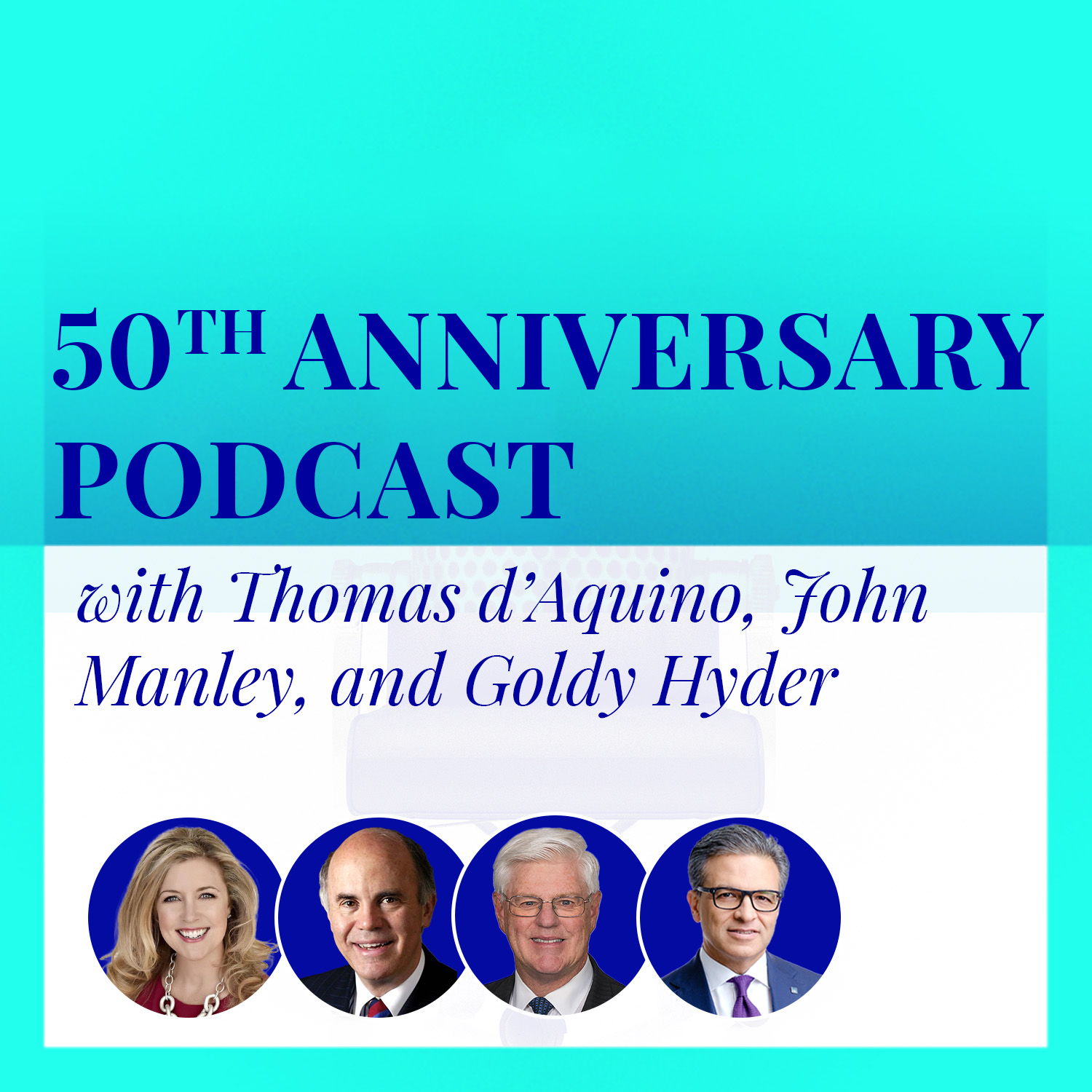
In this special episode of Speaking of Business, host Catherine Clark, discusses the 50th anniversary of the Business Council of Canada with founding president and CEO Thomas d’Aquino, former president and CEO John Manley, and current president and CEO Goldy Hyder.
From free trade and national unity to COVID and today’s geopolitical shifts, the conversation reflects on a half century of business leadership in helping build a stronger Canada.
Catherine Clark:
Welcome to of Speaking of Business, conversations with innovators, entrepreneurs and leaders. I’m Catherine Clark and it’s my pleasure to host this special edition of the podcast, marking 50 years of the Business Council of Canada.
In 1976, a small group of Canadian business leaders joined forces to form the Business Council on National Issues. Their goal was to work together to help strengthen the country’s economy, its social fabric and its democratic institutions.
Half a century later, the name of the organization has changed to the Business Council of Canada, but the goal remains the same.
For fifty years, the council has played a key role in much of Canada’s development as a nation.
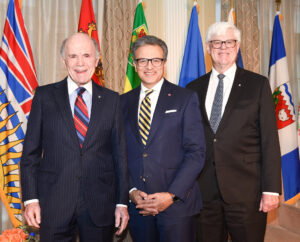
Today, we’re going to hear from three people who helped guide the Council’s work.
Thomas d’Aquino was founding president and CEO, leading the organization from 1981 to 2009.
Thomas d’Aquino:
I remember in my inaugural address when I laid out a vision for what I hope we could achieve and I coined the phrase way back then, which is used to this very day, and that is our goal was to build the best country in the world in which to live, to work, to invest, and to grow.
Catherine Clark:
The honourable John Manley took over the helm from 2010 to 2018:
John Manley:
The Council’s here to try to get the best overall framework for business to be able to succeed for us to attract and retain investment into Canada. This organization is about making Canada the most successful economy on the planet.
Catherine Clark:
And Goldy Hyder is the current president and CEO.
Goldy Hyder:
What we’re trying to do for the country, is really be the voice of what does it take to make Canada and keep Canada competitive in the world.
Catherine Clark:
I spoke with all three of them to hear their reflections on the council’s impact and I began by asking them to describe the Business Council of Canada in their own words.
Goldy Hyder:
It’s the only place where CEOs gather in the country. Largest employers in our country, collectively represent over 50% of the Toronto Stock Exchange. A very large part of our GDP. Probably over two million plus employees in the country. Very global, very national, very multi-sectoral. And it’s a privilege for me to be in their company on a regular basis, because they really have the pulse on the economy.
John Manley:
It’s an association of very senior business leaders in Canada that care about good public policy and care about business contributing to making Canada the best it can be.
Thomas d’Aquino:
An organization made up of CEOs and entrepreneurs dedicated to excellence in business. Of course, that’s number one, but also dedicated to promoting sound public policy for Canada and for the world. I think very well-positioned to do it because as an organization, it is responsible for the vast majority of investment of exports, research and development, philanthropy. So, this is a collection of very dedicated, I would add the word patriotic individuals who are trying to do the best for their businesses and for the country.
Catherine Clark:
That dedication to the country was reflected in the Council’s first report in 1978. It wasn’t about economic issues. Instead, it focused on parliamentary reform.
Thomas d’Aquino:
People thought, “What on earth is a business organization doing talking about parliamentary reform?” And that goes really to the nub of what the original idea was. I know it’s a cliche now to use the word thinking out of the box. At the time, it was not. Thinking out of the box meant you were not going to be a traditional business organization. You are going to be an organization that, of course, has to try to achieve excellence in your business enterprises, but you’re really going beyond the bottom line. The bottom line at that time, incidentally, was the Milton Friedman School that said the only purpose of a company is to build shareholder value and we said no. In this sense, we were really quite revolutionary. We’re going to go beyond that and dedicate ourselves, yes, to excellence in business, but also to making contributions in the public policy domain that would be seen to be sound and responsible. There was no other organization in the world at the time that had embraced this idea that the principal purpose of capitalism and capital is not just to generate more capital, but it is in fact to try to build a better Canada. That at the time was really quite revolutionary. My greatest surprise was the degree to which people came on board and said, “Yes, this is a mission that I think we should follow.” Hence, the example, first study was not on taxation, it was not on trade, it was on parliamentary reform.
Catherine Clark:
Some issues have remained a constant focus and challenge for the Council over the past fifty years. For example, interprovincial trade barriers and regulatory reform.
John Manley:
Let’s start with interprovincial trade. The problem there is there’s no one person in charge. There are 10 provinces, three territories, plus the federal government, and provinces can sometimes say they’re getting rid of interprovincial trade barriers until you go to their liquor store and find out that there’s no wine from name the province, right? So they say it, they don’t do it. It’s provincial jurisdiction. It’s an accumulation of many small things. There are not very many that are really big ticket. And plus you have complexity below the surface in everything from professional associations, trade associations, and unions that inhibit some of the changes that need to be made in interprovincial trade.
Goldy Hyder:
We’re a country of 40 million people that has 13 securities regulators. India has 1.4 billion people and a single securities regulator. We’re a country that has free trade with nearly two billion people, just not with ourselves in the interprovincial trade barriers that, again, are getting a lot of attention, but show me, like, “Take those things down.”
Thomas d’Aquino:
While the Business Council played a leadership role in free trade and in fighting deficits and actually in giving birth to the GST tax reforms, the fundamental tax reforms that were brought in the late ’90s and the beginning of the new century, the one area where we were not successful is on interprovincial barriers of trade. A premier of Saskatchewan, Roy Romanow, who I admire greatly, summed it up beautifully one day when I said to him, “Premier, why is it that we can’t achieve more on interprovincial barriers to trade?” And he said, “Tom, when I knock on doors, people are concerned about jobs. They’re concerned about crime in their communities, they’re concerned about this, that, or the other, their future of their kids, education. Do you know where interprovincial barriers to trade fit in my agenda? Like 101.” So part of the problem, Catherine, has been that the actual implementation of wiping away these internal barriers to trade, which would contribute enormously to our GDP, have been very, very difficult to achieve. Because when you get down to the granular stuff, people say, “Oh, my God. Are we going to have a six-month conversation about what kind of adhesive tapes we’re going to regulate?” you know?
John Manley:
On deregulation, it’s a thicket. I reached the point one time where I said, “Well, what we could do is simply pass one regulation that would say, you can’t do anything except as permitted.” And then I thought you could just have regulations that would say what you were permitted to do. I thought that would be far smaller than the ones that we’ve got where you’re supposed to be do anything except what you’re not allowed to do. So it is complicated. Some of them exist for good reasons. Some of them have outlived their usefulness. I think even in fairly recently, there was a regulation that could require hoteliers in the downtown Ottawa area to retain a stable for horses. So some of this stuff just never got updated, so it hangs around. If we want to get something big done here, you need to know that there’s a pathway to success. It does not mean that you do not need to be observant of the requirements to maintain a clean environment or to have a diverse workforce or any of those things, but you need to know that if you do those things, you can complete what you want to do. And what has deterred a lot of investment into Canada has been the fact that you can incur a lot of upfront costs in trying to get something done with no certainty that you will ever get to the end point of success in a reasonable period of time.
Goldy Hyder:
All of these are own goals. You cannot blame anybody for these things except ourselves. I’ve often said if Canada were discovered today, we probably would be a European Union of 13 entities. We would not be a country because there would be no national railway, no national highway, nothing that binds us the way we’re bound today. This is a possibility of really… We’re a young country. Let’s not panic here. We’re a toddler today in the big picture of the world. Let’s come out of this stronger. Let’s enter into our teenage years stronger, more confident. And I think that the sky is the limit for our country. It’s full of potential, if we can just get out of our own way.
Catherine Clark:
Another constant theme throughout the Council’s history has been Canada’s relationship with the United States, beginning with highly contentious free trade talks in the early 80’s.
Thomas d’Aquino:
When I first put forward the idea of a free trade agreement with the United States, it was hugely unpopular, including with our own members. So, in March of 1981, we had a stark meeting at the Chateau Laurier. Then Vice President George H.W. Bush came to the meeting. And at that meeting with about 12 of our members present, we put the idea to the vice president and said, “Don’t you think it’d be a good idea if Canada and the United States had a free trade agreement?” And the vice president said, “Well, what’s in it for the United States?” And my response was, “Mr. Vice President, an economy roughly the size of California.” He said, “You know what? That’s really worth thinking about.” From ’81 through to ’82 and ’83, we had to work very hard to convince our own members that we could do this because there was a general view that economy was 10 times larger than ours. How could we possibly compete? Well, the answer is the way you compete is not by building walls. You try to lower the barriers in order to try to build a more competitive workforce and enterprises that were more competitive. So, in the ’81, ’82, ’83 period, we convinced our members and then we went full scale in a national campaign. When the Mulroney government came on board in January of 1985 and the Shamrock Summit, the train left the station. But then we had an election in ’88. It was so corrosive that I was burned in effigy in front of the Chateau Laurier. I had a truckload of cow manure dumped on my driveway, a file that thick of death threats. Well, I don’t know if you remember that far back, but it was a very, very divisive election in which people felt very strongly. The argument was that we would lose our sovereignty, we would lose our water, we’d lose our healthcare, all of those things. Our counter argument was, and it’s very relevant to today, the U.S. is becoming increasingly protectionist. How can we survive in that protectionist environment? We must do it by building a bilateral free trade agreement, which we did. It was highly successful. It was a model to the world. It was the first bilateral free trade agreement of its kind that subsequently followed by, of course, the NAFTA in which again, the Council played the leading private sector role.
John Manley:
There’s some Newtonian physics involved in this. It’s a very proximate large economy. So the magnetic pull of that economy is irresistible. I mean, I’m all for diversification and certainly for building our economic resilience, but we can’t change the fact that we’re sharing the continent with the largest economy in the world. We’re not Australia. We’re not floating in the middle of the Pacific Ocean. We’re right there. So that economic draw is going to be irresistible. We benefited tremendously by the Canada-U.S. Free Trade Agreement and then by NAFTA because it facilitated the integration of our economies and enabled Canadian businesses to scale up serving the North American market from a Canadian base if they chose to do so. So that has had a very significant implications over the 40 years that that was our policy. Our economic policy, regardless of what party was in charge in Ottawa, it was always that policy. What we find ourselves in today is a situation where it’s no longer clear that we can expect that to continue. We opposed at the Business Council and the Canadian government supported that position that the USMCA, fine, you’d want to renegotiate it. They improved it in some respects, but it should not be reviewable after, after 10 years, that just creates an unnecessary uncertainty. Now we know that it’s not only reviewable, but it may not survive, and it certainly hasn’t survived the President’s use of Section 232 to impose tariffs for so-called national security purposes. So I think it’s going to continue to be so important because of its proximity. I was deeply involved in that after 9/11 as you might recall, making sure that we continued to have open access to the U.S. despite security concerns, but I now wonder how long those golden years, we may recall them as, will be able to continue.
Goldy Hyder:
Well, geopolitics is changing. Geoeconomics is changing. But you know what’s not changing, Catherine, is geography. We are where we are and there isn’t a country in the world that wouldn’t change places with us. Let’s be clear about that. And so in many ways we’ve won a geographic lottery, although I do tell my American friends, “You’re pretty darn lucky to have Canada and Mexico as your neighbors as well.” We had some conflicts. We had some issues over time. But generally speaking, things were hunky-dory. Right? And then one day we got jilted, and we woke up and said, “How dare you? What just happened here?” And we were hurt. We were deeply hurt. I was one of those people. We were all feeling like, “Come on, not Canada. Other than beat you in hockey pretty regularly, we’ve been pretty good.” Sure, we were laggards in our defence spending. Maybe you’ve got some legitimate concerns about border issues. Maybe there’s some other things that we can do together. Every country has protectionist elements to it. We were managing through it all. But the relationship got strained. We’re fighting hard to remind them of the integrated nature of our economy. How much they rely on our resources from potash to uranium to oil and gas. And, yes, some of the integrated supply chains that we have here. So it’s a difficult time, but we’re going to have to recognize that we need America, and America needs us. And frankly Canada, U.S., and Mexico need each other. That the competition is not within North America. It’s North America taking on the rest of the world and competing. And we live in the greatest continent in the world. We have a half a billion people here that are smart, that are hardworking. We’re rich in resources. We have an abundance of water. We have access to ports. We have innovative people. Let’s work together. And I’m still optimistic that soon we’re going to enter into a process of reviewing and renewing the USMCA. And over time the President, who has not really spoken against the USMCA, because it’s his deal, will see the merits of that. In fact, it’s the only thing that saved our economy, is the exemption of the USMCA. So we’ve been determined to not go with the bait, to not fall in the trap of the rhetoric. Again, stick to the facts. The facts are this is a relationship that works. It needs to be strengthened. Are there differences of opinion? Sure. But we are literally married to each other. There is no divorce possible between the United States and Canada.
Catherine Clark:
Over fifty years, the Council also dealt with unique, time-specific challenges. For Thomas d’Aquino, one of those issues was national unity.
Thomas d’Aquino:
No business organization in the world addressed constitutional and national unity issues as the Business Council did. We were extremely active at the time of the patriation of the Constitution in 1981. We took public positions strongly in favor of patriation. We took strong positions leading up to the referendum of 1995. The constitutional issues at the time and our advocacy at the time was probably the dominant issue of the Council and I would argue one of the dominant positions of the whole of the country. Again, people thought, “What are CEOs talking about not withstanding clauses and about changes to the Federation? Is that something they should be doing?” This is only proof positive of coming back to the original vision, and that is if you’re working to build a better country, ultimately, you’re working to build a better economy and you’re working to build the better conditions for individuals. When the Meech Lake Accord went down and the Charlottetown Accord went down, we pulled together a series of conferences called The Confederation for 2000 Conferences. We brought together people from all over the country to debate national unity. We produced a book out of that with all sorts of ideas and how we could build the Federation. Now we’re back where there are tensions. So, with the lessons learned, there is a role for business to play here because if the country is in danger of breaking up, we are in big trouble. If the Council can play a role as a bridge from east to west, center to south to north, then that is a role that we should play.
John Manley:
We dealt with what became the CUSMA negotiation, the renewal of the Canada-U.S.-Mexico trade agreement, NAFTA. It came within a hair’s breadth of just being canceled on six months notice by Donald Trump, and then we had to participate in support, at that time, it was the Trudeau government in negotiating it. Challenging time was on both sides, we were believers in Canada signing and getting engaged in trade agreements where they could. The TPP was being talked about. The Harper government wasn’t interested in being part of it. We had to push and push. And then we had to get involved in trying to get the U.S., who was actively involved, ironically, as it turned out, to allow Canada back in. And we needed to engage in Washington in order to make that happen. We had a near miss when Prime Minister Trudeau failed to show up at the signing ceremony for the TPP and we were almost excluded from it. As head of the Business Council, I had the privilege of being in Japan shortly after that and we were kind of excited by the high level access that we received from the Prime Minister’s office in Japan only to find out that I was to be berated for the performance of our prime minister. Similar to what happened to me when I visited Australia with Sam Boutziouvis who was working for the Council at the time shortly after the Harper government declined to allow BHP to acquire potash. And somehow I was invited to meet with the Australian energy minister. I was the first Canadian head over the parapet since that decision, and I nearly had my head blown off. So there were moments when I thought, “Wait a minute, I’m no longer responsible for those decisions, but here I am having to try to explain them, if not defend them.”
Goldy Hyder:
I’m really proud of the response the members had to COVID. Unparalleled experience for many of them. Existential for their businesses in many cases. Take Air Canada, when Calin Rovinescu was the CEO there. We talked quite regularly. He goes, “I lost all my revenue, Goldy. Pretty much all of it has disappeared. What am I going to do? How am I going to survive?” But I found out the caliber, the character, and the integrity of the people I have the privilege of representing every day, when those kinds of calls came in. You take a look at CAE where Marc Parent was the CEO at the time, and he called me, I remember that call so well, and he said, “What can I do to help?” The number of CEOs who called during that time and said, “What do you need from me? What can we do in Ottawa to get Ottawa supported to do what needs to be done?” And that sense of responsibility. The ability to lean in, the willingness to go beyond. You have companies in automakers like Linda Hasenfratz, who just like Marc and others said, “I’m going to make ventilators. I’m in the car parts business. I’m in the flight simulator business. But I’m going to make ventilators.” You take John Risley out of Newfoundland and others. People who said, “I want to get ahead of the rapid screening that’s coming.” All of these are examples of people who said, “I want to be a leader in that crisis. I want to lean in and help get us out of this situation.” Again, those are the things that… Safe landings don’t get reported, Catherine, but hopefully people who listen to this say, “Wow, I didn’t realize that.”
Catherine Clark:
Ultimately, the spark of an idea in 1976 led to business leaders coming together from different sectors and different parts of the country to collaborate in the best interests of Canada. It’s a flame that still burns today.
Thomas d’Aquino:
We right from the beginning had very strong representation from British Columbia and Alberta to some extent from Saskatchewan and of course from the Maritimes. The ability of those people to come together, see one another, debate issues together, come together in one place as the Business Council does so successfully now became very important. Now, some people write it off, “Well, that’s nothing, but networking.” No, no, it was much more than networking because all business, in fact, all things in life, whether it’s diplomacy or business, is based on relationships and therefore coming together on a regular basis, I could see with my own eyes that the opportunity to East meet West, the center to meet the outskirts really did work. It was an exchange of information and intelligence, but also, the embodiment that we’re all acting together here to try to build a better country. It’s not just our region or our city.
John Manley:
My ambition for Canada is that we are a beacon for the world of liberal democracy, a strong economy, a country of tolerance, and a country that really achieves the very best. I was never satisfied when we thought we did just well enough by winning the bronze medal. I want us to be a gold medal country, and that’s true in politics, in democracy. It’s true in business. It’s true in science and innovation and invention.
Goldy Hyder:
I want this moment for Canada to be a place where we go to wanting to celebrate success, to wanting to win the way we want to win in hockey. Let’s win in everything else that we can, because we have all of the ingredients and all of the elements to be leaders in the world.
Catherine Clark:
Those were the voices of Goldy Hyder, the honourable John Manley and Thomas d’Aquino: all three of them have served as president and CEO of the Business Council of Canada.
That’s a wrap for this special podcast marking 50 years of business leadership in Canada.
You can listen to more Speaking of Business conversations with innovators, entrepreneurs and leaders by searching for Speaking of Business wherever you get your podcasts. Or go to the business council dot ca for more information.
Speaking of Business is a production of the Business Council of Canada. Our thanks to Will McIntyre and Richard Villeneuve of Pop-up podcasting in Ottawa.
I’m Catherine Clark. Thank you for joining us.

From energy demand to economic opportunity: Heather Chalmers, GE Vernova Canada

Balancing Business and Social Mission: Zahid Salman, President & CEO of GreenShield

Global ambition, local partnerships: Vern Yu of AltaGas