




What Really Happened in Provincial Budget Season 2026 and What It Means for Ottawa’s Fiscal Update
As published on Substack
Summary:
- All provinces that have released budgets this year are projecting deficits in 2026–27, a rarity outside recessions.
- Spending increases drove the fiscal deterioration—not economic weakness.
- Inflation is still influencing provincial spending, and that could continue.
- Going forward, healthcare will play an even greater role in provincial fiscal and political decision making.
- Against that backdrop, businesses should advocate for provincial policies with limited spending impacts.
Introduction
Canada’s spring fiscal update arrives April 28 and speculation about what’s coming has already started. The prevailing narrative is that the government will have to balance ambitious plans with increasingly difficult economic conditions. But the 2026 provincial budget season, now nearly done, tells a different story.
I spent the last two years as Ontario Finance Minister Peter Bethlenfalvy’s economic advisor. I saw first-hand how the economic backdrop influences political decisions, and the way federal and provincial finances interact. Canada’s economic outlook is unquestionably uncertain, but the fiscal deterioration we’ve seen this year in provinces is the result of higher spending, not weaker revenues.
Deficits From Coast to Coast
Provincial budget season 2026 stood out for the breadth of fiscal deterioration. Just about every province forecasted a larger-than-previously-anticipated deficit. Every provincial government now expects a budgetary shortfall in 2026–27.
To be fair, as a share of GDP, only three of 10 provinces are forecasting record shortfalls (chart). Moreover, debt sustainability metrics largely aligned with prior projections, in part because of upward revisions to historical GDP figures and accounting changes.
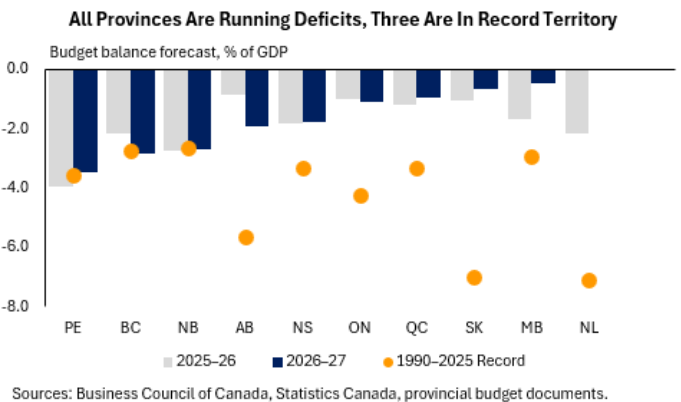
Still, such widespread deterioration and deficit spending are rare. The last time every province was in the red was at the height of the 2008–09 Global Financial Crisis. The last time every province ran back-to-back deficits was during the severe early 1990s recession.
A Spending Problem, not a Revenue Problem
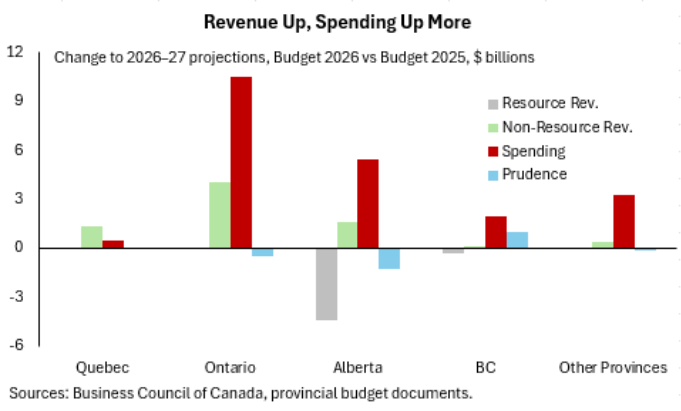
Unlike the 1990s, weaker revenue is not contributing to the deterioration today. In fact, across nine provinces, non-resource receipt projections for 2026–27 were raised by more than $7 billion. Alberta, which locked oil price assumptions before the Iran conflict, downgraded royalty projections, but is now poised for a windfall with crude values near $100/barrel.
Tax revenues are up because Canada’s economy has so far weathered tariff-related headwinds. Although 2026 growth forecasts have been revised down slightly, better-than-expected 2025 numbers and historical revisions leave GDP higher than assumed last year. For the four largest provinces alone, budget forecasts put this year’s nominal GDP almost $50 billion (more than $2,000 per person) higher than assumed in 2025. Keep in mind that federal and provincial budgets draw on the same data and pool of private-sector forecasts.
Of course, significant downside risk remains—it’s just not captured in base case revenue forecasts. Uncertainty related to the upcoming review of the US-Mexico-Canada Agreement continues to hold back business investment across the country, while surging oil prices could affect inflation, central bank policy, and mortgage renewals.
Deficits are mounting because spending is being driven by demographic pressures and the lingering effects of inflation. Total spending forecasts for this year are more than $21 billion higher than expected in 2025—three times the tax revenue windfall (chart). Province-wide program spending will approach 20 per cent of GDP in 2025–26 and 2026–27, levels not typically seen outside of recessions.
(Inflationary) History Repeating Itself
My experience working on the last two Ontario budgets underscores that inflation is still influencing expenditure patterns. Price pressures affected all programs, while institutional constraints limit how often ministries can revise outer year forecasts. Outside government, spending approvals are often framed as political decisions or questions of responsibility alone. But inflation’s insidious effects—on wage negotiations, contract values, and project costs—are bigger than any government or political party.
Data from all four large provinces suggest their budgets are at similar points in a well-documented inflationary cycle. Consistent with historical cross-country evidence, higher-than-expected inflation that began in 2022 initially boosted tax revenues, temporarily improving fiscal balances. Over time, however, more sustained pressure on spending eventually outstripped the improvement in revenues (chart).
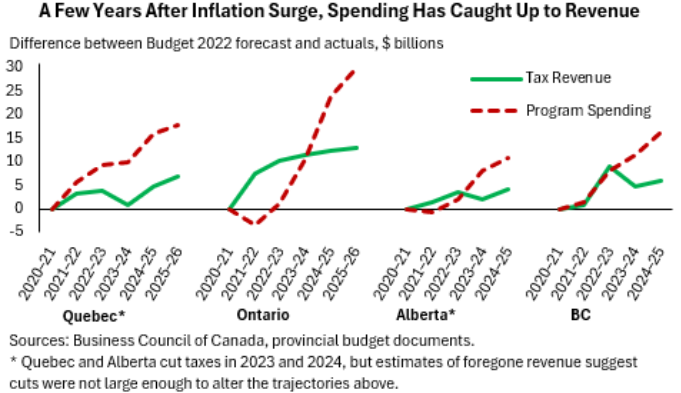
Historical evidence also suggests that inflation-related spending pressures might not yet have peaked. Meanwhile, Iran-related commodity price increases add further medium-term risks.
Health Will Continue to Drive Spending Trajectory
Beyond inflation, structural pressures are intensifying. Healthcare was again the single largest contributor to program expenditure increases in all four larges provinces. As Canada’s population continues to age, health’s share of spending is set to rise, reaching record highs near 50% in three provinces (chart).
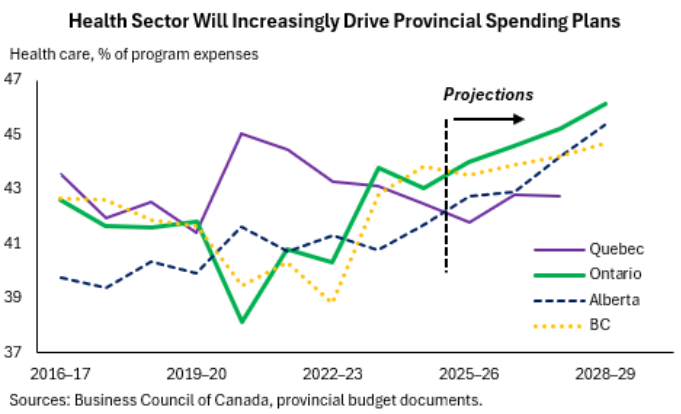
This yields three takeaways. First, healthcare will play a growing role in provincial fiscal trajectories. Second, achieving current healthcare spending targets could be challenging: the Parliamentary Budget Office predicts hefty longer-run annual health spending gains of four to five per cent under stable inflationary conditions. Finally, all this will increase pressure on Ottawa for higher federal transfers, which could crowd out room for economic priorities.
What to Expect When You’re Expecting Bigger Deficits
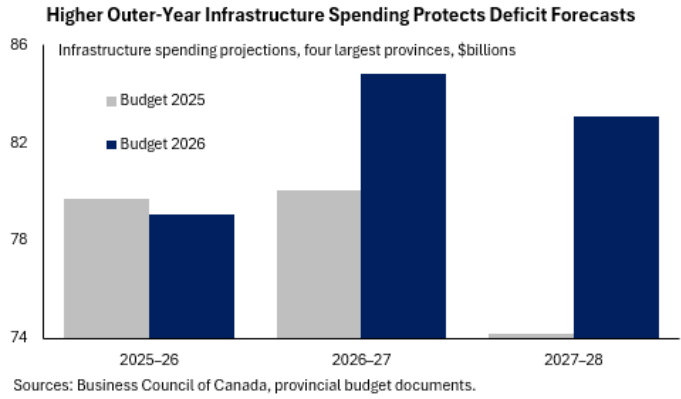
With fiscal room constrained, Canadians should expect new provincial and federal government measures beyond those already announced will try to minimize program spending impacts. This year’s budgets already lean that way, emphasizing tax credits linked to capital outlays, investment funds, capped industry support, regulatory reform, and a shift toward larger capital plans (despite pullbacks in BC) (chart).
Final Thoughts
Despite the current headlines, the upcoming federal fiscal update will likely show an improved economic outlook and revenue picture. But regardless of what happens to the economy, future provincial and federal budgets will be shaped by tough choices about costs, priorities, and the limits of public balance sheets.