










50 years of commitment to making Canada the best country in the world in which to live, work, invest and grow.
Our Story
In 1976, a small group of Canadian business leaders laid the foundations for an organization that was to have a significant impact on the country’s public affairs. They created what is today the Business Council of Canada, an association of public service-minded business leaders representing every part of the country and every major industry. Through the Council, they would seek to contribute personally to the development of sound public policy and the shaping of national priorities.
The Council was a positive manifestation of an idea: the belief that corporations and their leaders have a responsibility not only to their shareholders and other traditional constituents, but to society as a whole.
Early on, the Council defined its mandate to include a broad range of policy issues, not merely economic ones. Equally important, Council members were expected to consider issues from a national perspective, rather than focusing on the interests of individual companies and sectors.
As it enters its sixth decade, the Business Council of Canada remains committed to these same aims and principles, as a source of thoughtful, constructive advocacy in the national interest.
“We are creating a new force…one that will channel the ideas and the talents of Canada’s senior business leaders. Our objective is to help strengthen the country’s economy, its social fabric, and its democratic institutions.”
Our History
1976
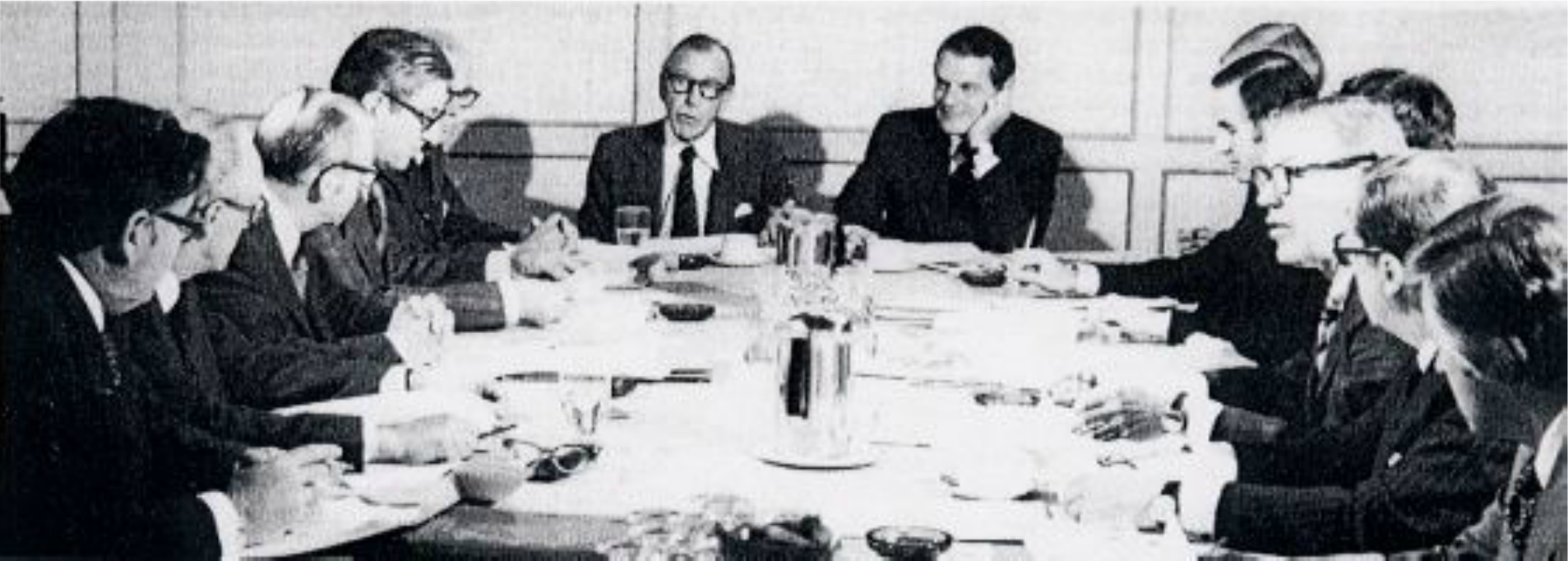
Founding – The Business Council on National Issues (BCNI) is founded by a small group of Canadian business leaders. Its mission is to “help strengthen the country’s economy, its social fabric, and its democratic institutions.” Since its genesis, the Council has always believed that the interests of businesses and all Canadians are synonymous.

Business Council on National Issues (BCNI) Logo
1977
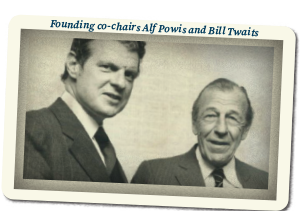
Bill Twaits of Imperial Oil and Alf Powis of Noranda are officially approved as the first co-chairs of the BCNI.
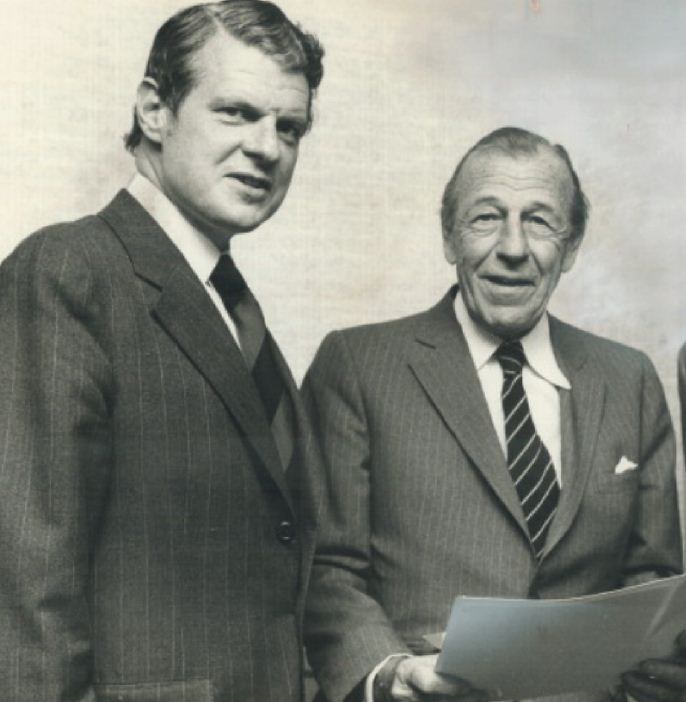
Founding co-chairs Alf Powis (Noranda) and Bill Twaits (Imperial Oil)
1978
BCNI opens its first office, located in Toronto, Ontario.
1979
The Council elects Jack Barrow as Chairman, succeeding the founding co-chairs. Barrow was the recently retired CEO of Simpson-Sears Limited and echoed the sentiments of his predecessors, aiming to “help government form policies in the interest of all Canadians.”
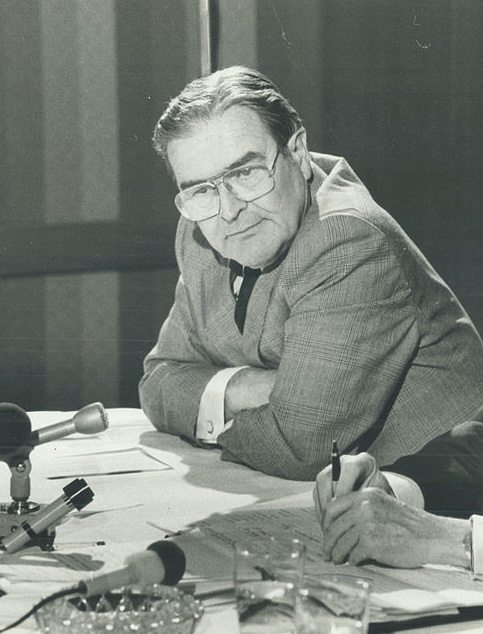
Jack Barrow: BCNI Chairman, succeeding the founding co-chairs
1980
Ahead of a constitutional conference, the Council issues a letter to provincial and federal officials outlining considerations to ensure the well-being of the Canadian economy.
1981
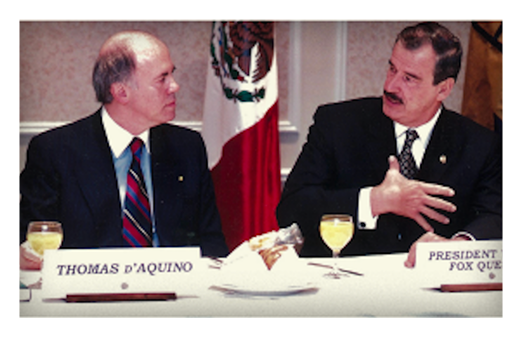
Thomas d’Aquino becomes the BCNI’s first President and Chief Executive Officer. The Council launches a major study on parliamentary reform aimed at improving government accountability and enhancing the role of backbench MPs in policy formulation.
1982
The BCNI calls for changes to the Foreign Investment Review Act (FIRA) to attract more foreign capital to Canada. In the same year, Council members work to forge a national consensus on energy policy.
1983
In a submission to the Parliamentary Task Force on Pension Reform, the Council recommends measures to ensure that Canada’s seniors are supported by secure and adequate income in their retirement years.
1984
Following two years of study, the BCNI recommends that Canada pursue a broad trade liberalization agreement with the United States.
1985
The Council calls for a “prudent, gradual reduction” in government regulation to stimulate economic growth and job creation.
1986
Concerned about rising government deficits, the Council recommends a multi-year strategy to stabilize and ultimately reduce Canada’s debt-to-GDP ratio.
In a major report on tax reform, the BCNI calls for sharp reductions in personal and corporate income tax rates, and the introduction of a broadly based “value-added transaction tax.”
1987
A Council statement describes government indebtedness as “the most serious, long-term threat” to Canada’s national prosperity.
1988
Council members play a key role in galvanizing public support for the Canada-U.S. Free Trade Agreement.
1989
The BCNI endorses Ottawa’s proposed Goods and Services Tax and the elimination of the existing manufacturers’ sales tax.
1990
In a news conference the Council issues an unprecedented joint economic statement criticizing the lack of fiscal restraint at both the federal and provincial levels, citing excessive spending and tax increases as catalysts for high interest rates that undermine the economic competitiveness of Canada. “If allowed to continue, high interest rates and the undisciplined spending and tax policies favoured by our government will erode the future standard of living of all Canadians.”
1991
The Council calls for constitutional recognition of Quebec’s linguistic and cultural distinctiveness, and the strengthening of Canada’s economic union. “The free flow of labour, capital, goods and services must be guaranteed under any new constituional arrangement.”
1992
A BCNI declaration urges companies across Canada to embrace the principles of environmentally sustainable development.
1993
The Council advocates for recognition of the Aboriginal right to self-government – “a critical first step in tackling the vast social and economic problems” in Indigenous communities.
In a letter to Finance Minister Paul Martin, the BCNI recommends that Ottawa adopt a credible plan to balance the federal budget no later than 1998-99.
1994
While welcoming the North American Free Trade Agreement, the Council says Canadian businesses must also consider emerging markets in Eastern Europe, Asia and Latin America.
1995
In a statement before the House of Commons Standing Committee on Finance regarding the upcoming federal budget, Thomas d’Aquino emphasizes the fiscal responsibility and political strength necessary in nurturing a competitive economy. He reiterates calls for a plan to balance the budget by 1998-99.
1996
The Business Council opposes calls for across-the-board tax cuts, continuing to urge the government to instead target Canada’s public debt problem.
1997
In Vancouver, the Council hosts the first-ever summit of business leaders from across the Asia- Pacific region.
1998
With the federal budget balanced, the Council proposes a two-year effort to pay down debt, followed by a program of accelerating tax cuts.
1999
Concerned about rising protectionism, the BCNI advises Prime Minister Jean Chrétien to push for a new round of worldwide trade talks.
2000
The Council hosts a national summit of leaders in business, government and academia to build consensus around a strategy for growth in the 21st century.
2001
Responding to the terrorist attacks of September 11, Canadian and U.S. business leaders underscore their shared interest in an open border.
2002
The Business Council on National Issues becomes the Canadian Council of Chief Executives (CCCE). Later the same year, Council members endorse a far-reaching set of principles on corporate governance and business ethics.

Canadian Council of Chief Executives (CCCE) Logo
2003
The CCCE launches its “North American Security and Prosperity Initiative,” aimed at modernizing the Canada-U.S. border and strengthening continental security.
2004
In its pre-budget submission, the Council warns of a “looming global slowdown” and recommends measures to stimulate future economic growth.
2005
The CCCE criticizes rapid increases in public spending and a lack of focus on Canada’s long-term competitive challenges.
2006
The Council welcomes Ottawa’s commitment to achieving the lowest effective marginal tax rate on new business investment in the G7.
2007
A Council Task Force on Environmental Leadership calls for a “coherent plan of action” on climate change, viewing sustainable development as a major economic opportunity.
2008
The world economy suffers its greatest crisis since the Great Depression. Canada is largely spared, but the Council warns of rising protectionsim.
2009
Business leaders in Canada and Europe applaud the start of negotiations toward a comprehensive economic partnership.
2010
The Honourable John Manley succeeds Thomas d’Aquino as President and CEO of the CCCE. The Council reiterates its call for a national approach to climate policy and carbon pricing.
2011
The CCCE launches “Canada in the Pacific Century,” a multi-year project emphasizing Asia’s importance to Canada’s economic future.

2012
The Council welcomes Canada’s decision to join the Trans-Pacific Partnership.
2013
The CCCE launches “Taking Action for Canada,” an initiative focusing on jobs and skills for the 21st century.

2014
The CCCE urges Canada’s premiers to show leadership in eliminating interprovincial trade barriers.
2015
The Business+Higher Education Roundtable is launched. The non-partisan, not-for-profit organization brings together Canada’s largest companies and leading post-secondary institutions to harness the strengths of Canada’s business and post-secondary education sectors. The aim is to build opportunities for young Canadians, boost innovation and drive collaboration.

2016
The CCCE elects its first female Chair, Linda Hasenfratz, and adopts a new name: the Business Council of Canada (BCC). The Council helps establish the Canadian Cyber Threat Exchange (CCTX) as Canada’s first private sector hub for cyber security threat information sharing and analysis.

Business Council of Canada (BCC) Logo

First female Chair, Linda Hasenfratz,

Canadian Cyber Threat Exchange (CCTX)
2017
The Council advocates for trade diversification as well as a successful renegotiation of the North American Free Trade Agreement.
2018
Goldy Hyder succeeds The Honourable John Manley as President and Chief Executive Officer of the Business Council of Canada.

2019
The Council launches the Task Force on Canada’s Economic Future, engaging Canadians from across the country to advance policies that enhance growth and ensure a better future for all.

2020
As a founding sponsor, BCC joins other organizations to launch a Canada-wide COVID-19 awareness campaign to help keep customers, employees and communities safe as the economy restarts.
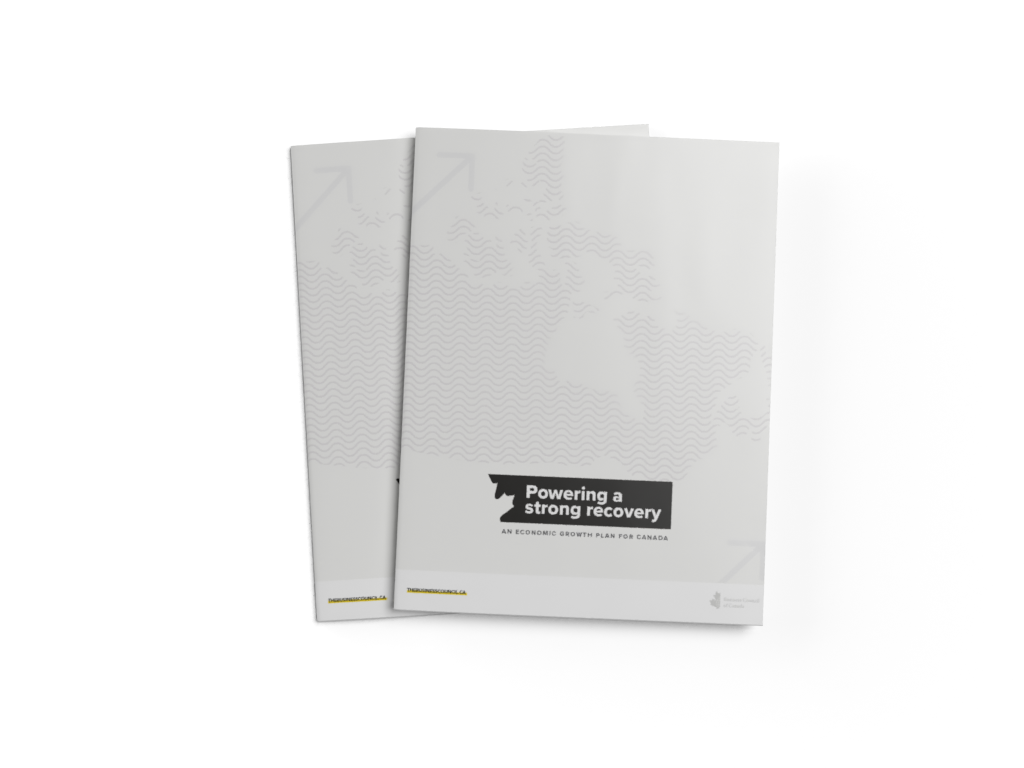
The Council releases “Powering a Strong Recovery: An Economic Growth Plan for Canada”, stressing the paramount importance of containing the virus while addressing long-standing structural weaknesses in the economy exacerbated by the pandemic.

2021
The Council helps launch the Coalition for a Better Future, a diverse group of Canadian leaders and organizations – across business, labour and civil society – working together to achieve a more inclusive, sustainable and prosperous Canada.

2022
The Council urges the federal government to adhere to a credible fiscal anchor and improve Canada’s economic competitiveness.
2023
BCC convenes the North American Business summit in Washington D.C. to bring together business leaders from Canada, the United States and Mexico with an aim of strengthening North American trade and relationships. Later in the year, the Council opens its first international office in Washington D.C
2024
The Council opens its second international office in Tokyo, with a focus on Canadian business interests in the Asia-Pacific region. Facing a new, unpredictable geopolitical reality, the Council releases Security and Prosperity, calling for the strengthening of Canada’s defence industrial base.
2025
In preparation for Budget 2025, the Council conducts extensive consultations with Canada’s top economic stakeholders, urging the government to unlock Canada’s full economic potential.
2026
The Business Council of Canada celebrates 50 years by celebrating its legacy while looking towards the future.